Understanding the author’s purpose is crucial for readers who want to unlock the deeper meanings behind a text. An author’s intent can transform a simple narrative into a powerful commentary, guide, or emotional journey, influencing how we interpret the writing. Did you know that authors typically write with specific goals in mind, such as to inform, persuade, or entertain? Recognizing these objectives not only enriches our reading experience but also sharpens our analytical skills, allowing us to engage more deeply with the material. In this exploration of “What Is the Author’s Purpose in This Excerpt? Explained,” we will break down the various motivations that authors may have and how these purposes manifest in their writing. By the end, you’ll see how distinguishing an author’s intent can illuminate underlying themes, enhance comprehension, and foster a more thoughtful interaction with literature. Let’s delve into the fascinating world of authorial intent and discover the significance behind the words on the page.
What Is Author’s Purpose? Understanding the Concept
Understanding the author’s purpose is crucial for interpreting any piece of writing effectively. At its core, the author’s purpose refers to the reason behind why the author crafted a particular text, which can range from informing the reader and persuading them to take action, to entertaining or expressing personal thoughts and emotions. Recognizing this purpose not only enhances comprehension but also enables readers to engage more deeply with the material.
An author typically writes with one (or more) of several key purposes in mind: to persuade, inform, entertain, or explain. Each of these purposes shapes the content, tone, and structure of the piece. For instance, a persuasive essay aims to convince the audience of a particular viewpoint and often employs emotional appeals and rhetorical questions. In contrast, informative texts are structured to present facts clearly and objectively, prioritizing clarity and logic over emotional engagement. This distinction is essential; understanding the author’s intent can guide readers in discerning nuances, such as bias or underlying messages, helping them to assess the text critically.
To grasp an author’s purpose effectively, readers should pay attention to various indicators within the text. These can include the language choices, tone, and structural elements. When an author uses urgent language or hyperbole, it may signal an attempt to sway the reader emotionally. Conversely, a neutral tone and straightforward language usually point towards an informative purpose. Additionally, analyzing the context in which the writer is operating-such as cultural or historical circumstances-can further illuminate their intentions.
Ultimately, remembering that every piece of writing is crafted with intent can cultivate a more appreciative and analytical reading experience. Engaging with texts through the lens of purpose invites curiosity and opens avenues for deeper exploration and connection with the material, transforming the reading process from a passive activity into an interactive journey.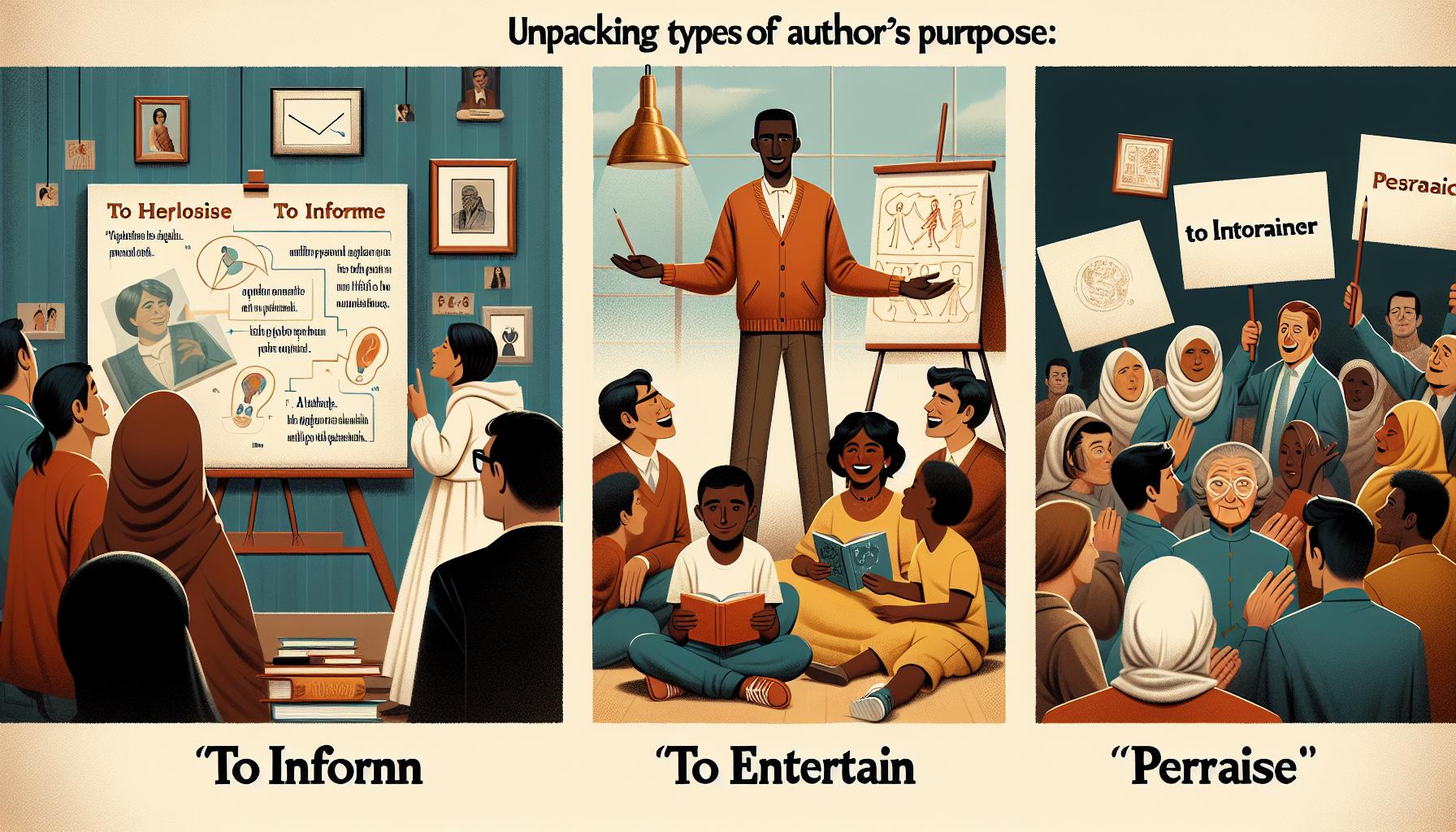
Unpacking Different Types of Author’s Purpose
Understanding the varied motivations behind an author’s writing can greatly enhance your reading experience. Each piece of literature is created with a specific purpose in mind, which can typically be categorized into distinct types. Recognizing these categories not only aids comprehension but also enriches the connection between the reader and the text.
Categories of Author’s Purpose
Authors might aim to fulfill one or more of the following purposes, each influencing the content and style of their work:
- To Inform: Informative writing seeks to educate the reader about a particular subject. This includes textbooks, news articles, and research papers. The language used is often straightforward, prioritizing clear facts and logical organization over emotional engagement.
- To Persuade: Persuasive texts are designed to convince the audience to adopt a specific viewpoint or take action. This purpose is typical in opinion pieces, advertisements, and political speeches where emotional language, rhetorical questions, and strong arguments are commonplace.
- To Entertain: Entertainment-focused writings, such as novels, short stories, and poems, aim to engage the reader’s imagination and emotions. The tone is often light-hearted or dramatic, employing vivid descriptions and creative plots to captivate the audience.
- To Explain: Expository writing aims to clarify concepts or processes with an analytical approach. It often appears in how-to guides, manuals, and instructional material, using logical structures and detailed explanations.
Examples and Variations
While these four categories summarize the main purposes, authors often blend them to create complex narratives. For instance, a novel may entertain while also conveying moral lessons (simultaneously providing insight). An editorial might inform about a pressing issue while attempting to persuade the reader to take action.
A key to identifying an author’s purpose is to look for clues in the text. This includes examining the choice of words, tone, and the overall structure. For instance, a formal tone with technical vocabulary might indicate an informative intent, while a humorous style could suggest the author aims to entertain.
Ultimately, understanding these varied purposes encourages an active reading process. As you engage with different texts, consider which purpose is most prominent and how it affects your interpretation. Embracing this mindset not only deepens your comprehension but also enhances your appreciation of the art of writing itself.
How to Identify Author’s Purpose in Texts
Identifying an author’s purpose is a critical skill that enhances comprehension and deepens engagement with texts. To discern why an author has crafted a particular piece, readers must be observant and analytical, looking for specific clues woven throughout the writing. Understanding an author’s intent not only enriches one’s reading experience but also supports critical thinking across various genres.
One of the first steps in identifying an author’s purpose is to examine the writing style and tone. Different purposes often manifest in distinct styles; for example, a formal tone with technical jargon typically indicates the intent to inform, as seen in academic articles or scientific reports. In contrast, a lighthearted or dramatic tone may suggest the author aims to entertain, as is common in fiction or poetry. Paying attention to word choice can also provide insights-persuasive texts often use emotionally charged language and rhetorical questions to sway the reader.
Another effective strategy is to consider the intended audience. Authors often write with a specific group in mind, which can inform the language, structure, and content of the piece. Questions to ponder include: What emotions is the author trying to evoke? What information do they wish to convey, and how do they expect the reader to respond? Understanding the context-such as historical background or societal issues-can further illuminate the reasons behind a piece of writing.
In practice, a focused reading approach can help in understanding authorial intent. Begin by annotating key passages that showcase emotional weight, factual statements, or narrative techniques. For instance, if you come across a section that provides detailed explanations, it’s likely that the author intends to inform or explain a concept. Ultimately, this analytical process not only uncovers the layers of purpose within a text but also invites readers to immerse themselves more fully in the literature they encounter.
Techniques for Analyzing Excerpts Effectively
Understanding an excerpt’s purpose is crucial but often challenging, especially when sifting through layers of meaning and expression. Each piece of writing is packed with nuance, and effective techniques for analyzing excerpts can reveal the author’s intent while enriching your reading experience. By employing focused strategies, readers can dissect texts more readily to unearth the underlying messages and goals.
Annotate the Text
Begin your analysis by annotating the excerpt as you read. Mark passages that stand out due to emotional weight or thematic significance. Pay special attention to:
- Emotional language: Words that evoke strong feelings may indicate whether the author aims to persuade or entertain.
- Factual statements: These often suggest an informative purpose, where the author’s goal is to educate the reader.
- Rhetorical questions: These can signal a persuasive intent, engaging the reader’s thoughts and encouraging them to reflect.
Utilizing different colors or symbols while annotating can help you categorize these aspects, making it easier to reference them later during your analysis.
Consider the Context
Understanding the context in which the text was written is essential for proper analysis. Context can include the historical background, the author’s personal experiences, and any societal issues relevant at the time of writing. Ask yourself:
- What was happening in the world when this was written?
- How does the author’s background influence their perspective?
- What issues does the text address that reflects its time period?
Such questions provide depth to your analysis and can often illuminate the author’s motivations behind their writing.
Identify the Audience
Another vital technique is to determine the intended audience for the excerpt. Analyzing language, tone, and complexity can help you understand who the author is addressing and why. For instance:
- If the author uses jargon or complex language, they may be writing for a specialized audience, aiming to inform.
- A conversational or accessible tone often suggests an intent to engage a broader audience or entertain.
Consider how the author’s choices might reflect an understanding of their audience’s needs and expectations.
By integrating these techniques, readers can enhance their analytical skills and develop a deeper appreciation for an author’s craft. Delving into excerpts with these strategies not only clarifies the purpose but also transforms the reading process into an engaging and thought-provoking exploration.
The Role of Context in Determining Purpose
Understanding how context shapes an author’s purpose is fundamental to deep reading and textual analysis. Context encompasses a broad spectrum of factors, including the historical background in which a text was produced, the author’s personal experiences and beliefs, and the cultural or societal issues that inform the writing. By examining these elements, readers can discern not only what a text is saying but also why the author has chosen to express it in a particular way.
One effective way to grasp the role of context is to consider specific historical events or cultural phenomena that may have influenced the author. For instance, literature produced during times of political unrest frequently reflects the tensions and ideologies of that era. A novel written during the Civil Rights Movement might embody themes of injustice and resilience, revealing the author’s intention to raise awareness or provoke change. Exploring the circumstances surrounding the writing can illuminate how the author’s experiences and observations contributed to their purpose.
Moreover, the author’s background can significantly inform their perspective and intentions. An author who experienced poverty might write with a sense of urgency regarding social issues, while someone with a privileged background may approach topics of inequality from a different vantage point. This aspect of context is crucial in determining whether a text serves to educate, persuade, or entertain. For example, in Mary Shelley’s “Frankenstein,” her experiences as a woman in a patriarchal society inform the narrative, compelling readers to reflect on themes of creation and responsibility within their contemporary contexts.
To analyze context effectively, readers should ask probing questions. Consider how the author’s historical moment might shape their message, what personal experiences could inform their writing, and what societal critiques are embedded within the text. This approach not only enhances textual understanding but also cultivates a richer engagement with the material, allowing readers to appreciate the intricate layers that underlie an author’s purpose. In engaging with context, readers become more discerning and informed interpreters of literature, which ultimately enriches their reading experience and appreciation for the text.
Common Mistakes in Identifying Author’s Intent
Identifying an author’s intent is a layered process that can trip up even the most diligent readers. One common mistake is oversimplifying the purpose into binary categories-just viewing a text as purely informative or entertaining. The reality is that an author’s intent often intersects multiple purposes. For instance, a novel might aim to entertain while also educating its audience about significant social themes, such as race or class disparity. Recognizing this complexity allows for a deeper comprehension of the text.
Another frequent error occurs when readers project their own biases or experiences onto the text rather than considering the author’s historical and cultural context. An author writing in a post-colonial environment might express intentions that differ widely from those of a contemporary writer in a more stable society. Failing to account for these differences can lead to misconceptions about the message and intended audience. Always take a step back and reflect on how an author’s background and the era in which they wrote influence their work.
Additionally, many readers overlook the nuances of language and tone, which can significantly convey an author’s purpose. The choice of specific words, whether they evoke emotion, humor, or urgency, can all point toward a deeper intention. For example, in a satirical piece, the humor may mask a critical social commentary that might go unnoticed without careful analysis. Thus, paying close attention to linguistic choices and their implications is vital for accurately decoding intent.
Lastly, a prevalent mistake is assuming that an author’s purpose remains static across different genres. The conventions and expectations of a literary genre can shape, and sometimes limit, how purpose is expressed. For example, while a traditional tragedy may aim to elicit pity and fear, a contemporary feminist novel may skew toward empowerment and critique of patriarchal structures. Acknowledge the genre’s influence to fully understand the author’s intent in different texts.
Engaging with Text: Reader’s Role in Purpose
Engaging with a text involves an active partnership between the reader and the author, where understanding the author’s purpose becomes crucial. A reader’s role isn’t passive; it requires curiosity, critical thinking, and attentiveness to nuances that inform the work’s underlying messages. This engagement allows readers to decipher not only what the author intended to convey but also how that intent resonates with their own experiences and perspectives.
To effectively grasp the author’s purpose, readers should begin by asking specific questions as they navigate the text. For example: What themes are being explored? What emotions does the language evoke? Who is the intended audience? By framing their reading experience around these inquiries, readers can uncover dimensions that may otherwise remain hidden. Additionally, recognizing the interplay of various literary devices-such as tone, metaphor, and symbolism-enhances understanding. For instance, a seemingly straightforward narrative may include layers of irony that invite the reader to question surface meanings, thus enriching the interpretative process.
Recognizing Context and Tone
A critical aspect of engaging with text is the ability to consider the context in which it was written. Historical, cultural, and social factors play pivotal roles in shaping an author’s perspective and, subsequently, the purpose of their writing. Readers should be aware of the time period of the work, the author’s background, and any external circumstances that could influence the narrative. For example, literature produced during times of social upheaval often reflects authors’ intentions to comment or persuade concerning those issues. By situating the text within its larger context, readers can cultivate a deeper understanding of the author’s purpose and the significance of the text in broader societal conversations.
Active Reading Strategies
To further enrich their engagement, readers can employ several active reading strategies. Taking notes while reading can help capture thoughts and initial reactions. Highlighting or annotating passages that strike a chord can guide subsequent analyses, allowing the reader to return to these ideas later. Discussion with peers can also illuminate different interpretations and encourage a broader exploration of the text’s purpose. By exchanging perspectives, readers may discover new insights into the complexities of the author’s intent.
In summary, engaging with text requires an interactive mindset. Acknowledging the role of the reader is essential in exploring an author’s purpose. Readers equipped with the right questions, contextual awareness, and active reading strategies will find themselves better able to unlock the deeper meanings behind the text, ultimately leading to a richer and more fulfilling reading experience.
Examples of Author’s Purpose in Literature
Understanding the diverse ways authors express their purposes can enhance our reading experience significantly. Literature is filled with texts that serve a multitude of aims, from evoking thought to entertaining or persuading. These purposes can often be gleaned through the analysis of specific excerpts and by considering the broader context in which a piece is situated.
A classic example can be found in George Orwell’s “Animal Farm,” which serves to both entertain and inform. On the surface, the story presents itself as a simple fable about farm animals; however, its underlying purpose is to critique totalitarian regimes, specifically Stalin’s Soviet Union. Through allegory, Orwell aims to persuade readers of the dangers of oppressive leadership while also informing them of historical events in a more engaging manner. The dual purpose invites readers to reflect on the relevance of these themes in contemporary society.
In contrast, some texts mainly aim to entertain. J.K. Rowling’s “Harry Potter” series immerses young readers in a fantastical world, sparking their imagination while also addressing critical themes of friendship, bravery, and the battle between good and evil. The narrative cleverly entices the audience through its magical elements, all the while nudging them toward important life lessons about loyalty and resilience. Understanding that Rowling’s primary intent is to entertain helps readers appreciate the vibrancy and creativity of her writing.
Moreover, non-fiction works often prioritize informing. In “The Immortal Life of Henrietta Lacks,” Rebecca Skloot delves into the life of a woman whose cancer cells led to groundbreaking medical discoveries. Here, the purpose is to enlighten readers about ethical issues in medical research, the intersection of race and science, and the human dignity that often gets overlooked in such discussions. Skloot’s narrative bridges academic information with personal anecdotes, making complicated themes more accessible and engaging for the reader.
Through these examples, it’s evident that the author’s purpose can shape not only the narrative structure and style but also the reader’s emotional and intellectual engagement with the text. Recognizing whether an author aims to entertain, inform, or persuade allows for a deeper connection to their work and enhances critical thinking skills. Each literary piece is an opportunity for discovery, as understanding the goals behind the words can unlock a richer reading experience.
The Impact of Author’s Purpose on Narrative Style
Understanding how an author’s purpose influences narrative style can unlock deeper layers of meaning in a text. Every choice an author makes-from the structure of paragraphs to the use of descriptive language-serves a particular intent, whether it be to persuade, inform, or entertain. When readers recognize these strategies, they engage more fully with the work, enhancing their critical thinking and appreciation of literature.
One significant aspect of narrative style is the use of tone, which can change dramatically based on an author’s intent. For instance, in Joan Didion’s “Slouching Towards Bethlehem,” the tone is reflective, with Didion’s purpose being to inform readers about the complex social changes occurring during the 1960s. Her narrative style, characterized by detailed observations and a contemplative voice, invites readers to ponder the implications of the historical moment she describes. In contrast, a satirical piece like Jonathan Swift’s “A Modest Proposal” employs a biting tone to persuade readers to take action regarding social injustices, making the stark contrast in tone a powerful vehicle for his critique. This interplay between purpose and narrative tone is essential for shaping the reader’s emotional response.
Authors also manipulate narrative structure to serve their purposes effectively. For example, in Mark Twain’s “The Adventures of Huckleberry Finn,” the first-person narrative allows readers direct access to Huck’s thoughts and feelings, drawing them into his moral dilemmas and adventures. This stylistic choice reflects Twain’s purpose of illustrating the absurdities of societal norms and racism in America. The informal, conversational style reflects Huck’s character and engages the reader more intimately, making the story’s serious themes more relatable.
Furthermore, genre plays a vital role in determining how an author’s purpose manifests through narrative style. In romance novels, the emphasis is often on emotional resonance and character development, as seen in Jane Austen’s works, which aim to entertain while also critiquing societal norms regarding marriage and class. Conversely, in a thriller like Gillian Flynn’s “Gone Girl,” the fragmented narrative style reflects the unstable emotional landscape and ulterior motives of the characters, enhancing the suspenseful impact of the story. These stylistic choices, driven by the author’s purpose, shape not only the structure of the narratives but also how readers experience and interpret the unfolding events.
Recognizing the significance of an author’s purpose allows readers to navigate texts with greater insight. When a reader can articulate the author’s intent, they can better appreciate the nuances of narrative style-including tone, structure, and genre-and how these elements work together to create an immersive reading experience. As a result, this understanding empowers readers to engage more critically with literature, uncovering the complex layers behind the words on the page.
How Tone Influences Author’s Intent
In literature, tone acts as a subtle yet powerful force that can significantly influence an author’s intent and how a reader perceives a text. Tone encompasses the author’s attitude toward the subject, characters, or audience, conveyed through word choice, sentence structure, and punctuation. It is this nuanced quality that guides the reader’s emotional experience and shapes their interpretation of the narrative’s deeper meanings. Understanding how tone operates can enhance your comprehension of the author’s purpose and intent behind the writing.
For instance, consider the stark difference in tone between George Orwell’s “1984” and J.K. Rowling’s “Harry Potter” series. Orwell’s tone is often bleak and foreboding, reflecting his purpose to critique totalitarianism and evoke a sense of urgency and caution about governmental overreach. This serious tone aligns seamlessly with the content’s themes of oppression and surveillance. In contrast, Rowling adopts a more whimsical and adventurous tone in her portrayal of the wizarding world, aiming to entertain while simultaneously conveying messages about friendship, bravery, and the struggle between good and evil. Here, the tone invites readers of all ages to engage with the story and its moral lessons in an accessible way.
### The Role of Tone in Shaping Reader Response
Tone directly influences how readers emotionally respond to a text. A sarcastic or ironic tone, like that found in works by authors such as Kurt Vonnegut, can provoke laughter while simultaneously critiquing serious societal issues. In contrast, a somber or reflective tone encourages introspection, prompting readers to connect personally with the themes presented. Recognizing these tonal shifts allows readers to decipher the author’s underlying messages and intentions more clearly.
To analyze tone effectively, readers can ask several guiding questions:
- What adjectives best describe the tone of the passage?
- Which words or phrases contribute to this tone?
- How does the tone align with or contradict the themes being explored?
- What emotional responses does the tone elicit from you, the reader?
By critically engaging with these questions, readers can unravel the complexities of the text and enhance their understanding of the author’s purpose and intent, leading to a richer reading experience. Thus, the interplay between tone and authorial intent is a foundational element of effective literary analysis, inviting deeper contemplation and dialogue about the text’s broader implications.
Analyzing Purpose Across Different Genres
Literature serves as a vast tapestry woven with diverse genres, each thread reflecting unique styles and purposes. Analyzing an author’s purpose across multiple genres reveals not only their intent but also enriches the reader’s understanding and appreciation of the text. For instance, the purpose can shift dramatically between genres such as fiction, poetry, journalism, and academic writing, each utilizing different tools to connect with their audiences.
In narrative fiction, authors often seek to entertain while simultaneously exploring deeper themes such as identity, conflict, or morality. Classic romances like Jane Austen’s *Pride and Prejudice* aim to entertain through humorous social commentary, but also provoke thought about societal structures and personal growth. Conversely, detective stories such as Arthur Conan Doyle’s *Sherlock Holmes* blend entertainment with a purpose to engage readers in critical thinking, urging them to solve the mystery alongside the characters.
Genre-Specific Purposes
Understanding the nuances of purpose in poetry can also heighten one’s literary experience. Poets employ imagery and metaphor not only to evoke emotion but to provoke reflection. For example, in Robert Frost’s *The Road Not Taken*, the simplicity of the narrative carries layers of meaning about choice and consequence. This dual purpose enriches the text, inviting readers to consider their own life’s pathways.
Similarly, in journalism, the purpose shifts to inform and persuade. Articles written to illuminate current events or societal issues must balance factual reporting with compelling narratives to engage readers. Op-eds, for instance, aim to persuade the audience with a strong personal or editorial viewpoint while grounding arguments in factual evidence. This blending of narrative style with persuasive writing showcases how purpose shapes the structure and delivery of information across genres.
By recognizing these distinctions, readers can enhance their critical analysis when approaching varied texts. Consider how an author’s purpose impacts not only the content but also the format and style. For instance, a memoir will often include emotional anecdotes and reflective insights that might not appear in a scientific article, which prioritizes evidence and clarity. By exploring the explicit and implicit purposes in different genres, readers not only gain insights into the author’s intent but also develop a more profound appreciation for the art of writing itself.
Connecting Author’s Purpose to Theme and Message
Understanding the link between an author’s purpose, theme, and message is fundamental in grasping the depths of literary works. The author’s purpose serves as a compass guiding the narrative, while the theme represents the underlying ideas or messages that resonate throughout the text. When readers identify the author’s intention-whether to inform, persuade, or entertain-they glean insights into the greater meanings embedded within the story.
For instance, consider George Orwell’s *Animal Farm*. The purpose of Orwell’s allegorical tale is to critique totalitarianism and explore the corrupting influence of power. By understanding this intent, readers can appreciate how themes of oppression and betrayal emerge through the characters’ actions and the narrative’s progression. The message becomes clear: unchecked power leads to insatiable greed and moral decay. Thus, engaging with the text on a deeper level requires not just recognizing the author’s purpose but also analyzing how it shapes and informs the themes presented.
Identifying Connections
To effectively connect an author’s purpose to the themes and messages within a text, readers can use specific strategies:
- Ask Questions: Inquire about the motivations behind the narrative. What is the author aiming to achieve with the story?
- Analyze Language: Examine the choice of words and phrases. How do they reflect the themes and purposes at play? For example, descriptive language may enhance themes of beauty or horror.
- Look for Repetition: Identify recurring ideas or phrases. Patterns often signify the author’s key messages and themes.
- Contextual Considerations: Reflect on the historical, cultural, or societal context in which the work was created. This can provide valuable insights into its themes.
By employing these techniques, readers can form a comprehensive understanding of how an author’s purpose strengthens the thematic fabric of the text, leading to more profound interpretations and discussions. Through this lens, literature transforms from mere storytelling into a rich exploration of human experience, ethics, and societal constructs, enabling the reader to connect more personally with the work and its implications.
Q&A
Q: What are the different types of author’s purpose?
A: The main types of author’s purpose include *to inform, persuade, entertain,* and *describe.* Understanding these categories helps readers analyze the intent behind a text, aiding in deeper comprehension. Refer to the section on “Unpacking Different Types of Author’s Purpose” for examples and applications.
Q: How can I identify the author’s purpose in a text?
A: To identify the author’s purpose, examine key elements such as *the title, tone, word choice,* and *context.* Look for clues in the introduction and conclusion, which often reveal the main intent. Check “How to Identify Author’s Purpose in Texts” for a step-by-step guide.
Q: Why is understanding the author’s purpose important?
A: Understanding the author’s purpose is crucial because it enhances *comprehension* and *engagement* with the text. It allows readers to critically evaluate content and discern underlying messages. Explore “The Role of Context in Determining Purpose” for insights on contextual relevance.
Q: What mistakes do readers commonly make when identifying author’s intent?
A: Common mistakes include relying solely on *personal interpretation* or ignoring *contextual clues.* Readers may overlook subtle hints in the narrative that indicate the author’s true intent. For a more thorough analysis, refer to the section on “Common Mistakes in Identifying Author’s Intent.”
Q: How does tone influence the author’s purpose?
A: Tone significantly affects the author’s purpose by conveying emotions and attitudes that shape the reader’s understanding. A *sarcastic tone* can suggest critique, while a *serious tone* might indicate a call to action. Delve deeper in “How Tone Influences Author’s Intent” for examples.
Q: Can the author’s purpose change throughout a text?
A: Yes, an author’s purpose can evolve based on *narrative developments* or changes in audience engagement. Analyzing shifts in tone or style can reveal these changes. Refer to “Analyzing Purpose Across Different Genres” for more on this topic.
Q: How can context aid in determining the author’s purpose?
A: Context provides vital background information-such as historical, cultural, and situational factors-that influences the author’s intent. Understanding the context enriches interpretation and comprehension. Visit “The Role of Context in Determining Purpose” for detailed strategies.
Q: How does an author’s purpose relate to the theme of a work?
A: An author’s purpose is closely linked to the *theme,* as the purpose often drives the message the author wants to communicate. Identifying the purpose can enhance understanding of the theme. For more, see “Connecting Author’s Purpose to Theme and Message.”
Future Outlook
Understanding the author’s purpose can transform your reading experience and deepen your analytical skills. We’ve explored how to discern the motivations behind literary choices, but the journey doesn’t stop here. Ready to put your newfound insights into practice? Dive into our article on “Analyzing Literary Devices” and enhance your comprehension even further.
Don’t forget to subscribe to our newsletter for more tips on literary analysis and exclusive content that will elevate your understanding of texts. If you have questions or thoughts about this topic, share them in the comments below-we’d love to hear from you! Remember, each reading is an opportunity for discovery; embrace it and unlock the full potential of your literary journey.